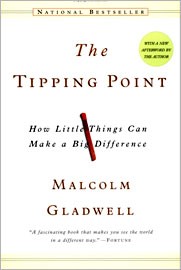
The Tipping Point
Malcolm Gladwell
Reading Notes
Gladwell's taxonomy of social influence — Connectors, Mavens, and Salesmen — gave me a language for something I had observed but could not articulate. In every community I have been part of, there are people who seem to make things happen not through authority but through their position in the social graph. Connectors are the ones who bridge otherwise disconnected groups. Mavens are the ones people trust for information. Salesmen are the ones who can make you feel something. What Gladwell helped me see is that these are not personality types — they are functional roles in the spread of ideas. And if you understand these roles, you can deliberately design for them when building products or movements.
The 'stickiness factor' was the concept that changed how I think about the projects I build. Gladwell argues that the content of a message matters as much as the network it travels through. Something can reach millions of people and still fail to stick — to change behavior, to be remembered, to be acted upon. This is the difference between virality and impact. I started evaluating my own work through this lens: is this thing I am building merely shareable, or is it sticky? Does it change how someone thinks or acts after they encounter it? That distinction has become one of my primary design criteria.
The 'power of context' chapter was perhaps the most counterintuitive. Gladwell shows that human behavior is far more sensitive to environmental conditions than we assume. The broken windows theory, the Stanford prison experiment, the Kitty Genovese case — all illustrate that small contextual changes can produce dramatic behavioral shifts. This has direct implications for product design: if you want to change user behavior, do not try to change the user — change their environment. It also made me rethink how I analyze social movements. The protests, viral campaigns, and political shifts I study in my economics courses are not just about brave individuals or powerful ideas — they are about the precise environmental conditions that allow those individuals and ideas to reach critical mass.
Key Takeaways
- → Connectors, Mavens, and Salesmen are not personality types but functional roles in idea propagation — design for them deliberately.
- → Virality without stickiness is noise. The real question is not 'will people share this?' but 'will it change how they think or act?'
- → Context shapes behavior more than character does — to change outcomes, redesign environments rather than trying to persuade individuals.
- → Social epidemics follow the same rules as biological ones — they require the right agents, the right message, and the right conditions to reach a tipping point.
“The tipping point is that magic moment when an idea, trend, or social behavior crosses a threshold, tips, and spreads like wildfire.”
— Malcolm Gladwell