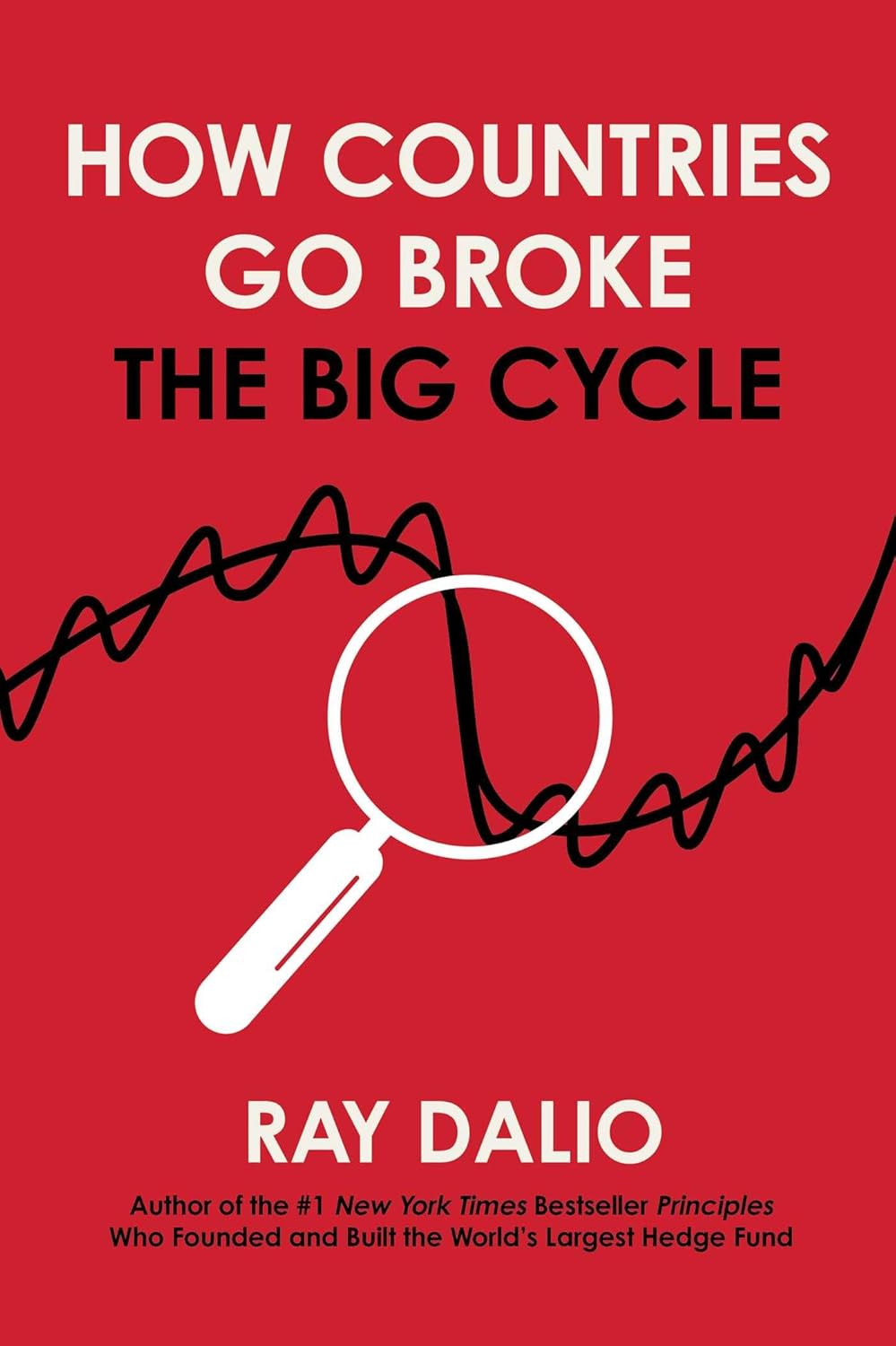
How Countries Go Broke
Ray Dalio
Reading Notes
Dalio's framework for understanding sovereign debt crises finally gave me language for something I'd been sensing intuitively — that the fiscal trajectories of most major economies are not just unsustainable, they follow a remarkably predictable pattern. The big debt cycle he describes is almost mechanical: governments accumulate debt during good times, reach a tipping point where servicing costs crowd out productive spending, then face the impossible choice between austerity and monetization. What struck me most is how consistently governments choose monetization — printing money and devaluing the currency — because the political cost of austerity is always immediate while the cost of inflation is diffuse and delayed.
The historical case studies are where the book really comes alive. Weimar Germany, Argentina's serial defaults, Zimbabwe's hyperinflation — Dalio shows that these aren't exotic anomalies but extreme versions of the same dynamic that plays out in every overleveraged economy. The Weimar case is particularly instructive: the Reichsbank didn't set out to destroy the currency, it simply kept solving the immediate problem (paying reparations, funding government operations) without acknowledging the cumulative cost. Every central bank governor in those case studies believed they were managing a temporary situation. None of them thought they were the ones who would break the system.
Reading this as a Chinese economics student adds a specific layer of urgency. China's local government debt, the LGFV problem, the real estate sector's unwinding — these map uncomfortably well onto Dalio's early-stage warning indicators. I don't think China is headed for a Weimar scenario, but the book made me realize that the question isn't binary (collapse vs. stability). The real question is how much of the adjustment cost gets passed to ordinary people through currency depreciation, financial repression, or reduced public services. Dalio's framework suggests that the method of resolution matters enormously for who bears the burden, and that's something I want to think about much more carefully.
What I appreciate most about Dalio's approach is its unsentimental empiricism. He doesn't moralize about debt being 'bad' — he simply observes that debt cycles have a mechanical logic, and that ignoring that logic doesn't make it go away. The book is essentially a plea for fiscal literacy at the civilizational level: if citizens understood how debt cycles work, they might demand better choices from their governments before the tipping point arrives. Whether that's realistic is another question, but the diagnostic toolkit alone makes this essential reading.
Key Takeaways
- → Sovereign debt crises follow a remarkably consistent pattern across centuries — the specifics change, but the underlying dynamic of over-borrowing, monetization, and currency devaluation repeats with mechanical regularity.
- → Governments almost always choose inflation over austerity because the political incentives favor deferring pain — understanding this bias is essential for anticipating policy responses.
- → The method of debt resolution (restructuring, inflation, austerity, or growth) determines who bears the cost — this distributional question is ultimately a political one, not a technical one.
- → China's current fiscal challenges — local government debt, property sector deleveraging, demographic headwinds — fit uncomfortably well into the early stages of Dalio's big debt cycle framework.
"If you don't understand debt cycles, you don't understand how the economic machine works, and if you don't understand how the economic machine works, you can't protect yourself."
— Ray Dalio