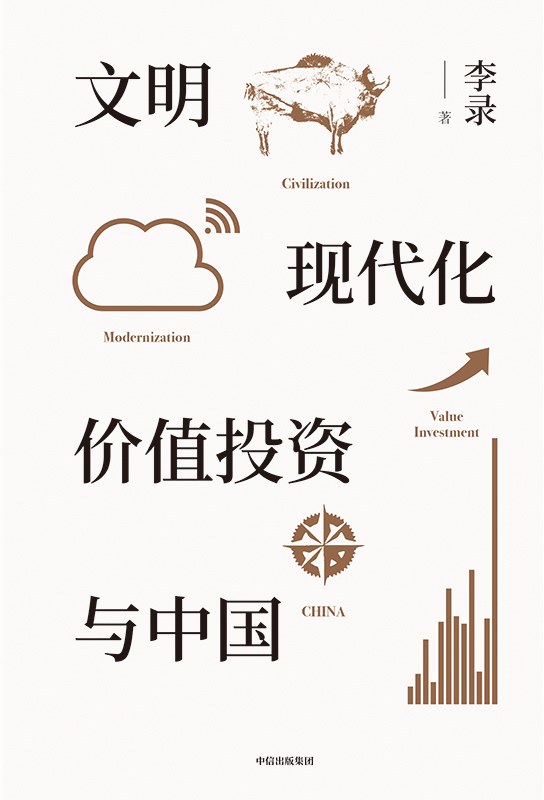
文明、现代化、价值投资与中国
李录 (Li Lu)
Reading Notes
Li Lu occupies a genuinely rare position: he is the only outside fund manager Charlie Munger ever entrusted with his own capital. That fact alone would make anything he writes worth reading. But what makes this book unusual is that Li Lu does not write a conventional investing manual. Instead, he attempts something far more ambitious — a unified theory that connects the deep history of human civilization to the logic of value investing, and then applies both lenses to China's economic trajectory. The result is a book that reads less like finance and more like intellectual history with a portfolio attached. For someone studying economics in China, where most investing literature is either imported American doctrine or speculative noise, this felt like encountering a framework built from the ground up for the world I actually inhabit.
The core of the book is Li Lu's '3.0 civilization' thesis: that humanity has passed through foraging (1.0), agriculture (2.0), and is now in the scientific-industrial phase (3.0), and that the internal logic of each phase determines its economic and political possibilities. What makes this more than a neat periodization is how he uses it to reframe China. In his telling, China's modernization is not a story of copying Western institutions or playing catch-up on someone else's scoreboard. It is a civilization with its own deep continuities entering the 3.0 era on terms shaped by its particular history — the imperial examination system's meritocratic logic, the Confucian emphasis on long-term stewardship, the sheer scale of its internal market. He is not naive about China's problems, but he refuses the framing that modernization means Westernization. That distinction matters enormously to me, because it matches what I observe: China is building something that borrows freely but does not replicate.
Where the book comes alive most personally is in how Li Lu bridges civilizational thinking and investing practice. His argument is that value investing — patient capital, compound growth, margin of safety — is not just a technique but a worldview aligned with how 3.0 civilization actually generates wealth. Speculation is a 2.0 habit; real returns come from understanding and riding the productive engine of modernity. Reading this as a Chinese student surrounded by peers obsessed with short-term trading apps and crypto volatility, the message landed hard. It is a quiet rebuke of the gambling mentality that dominates retail investing here, but framed not as Western moral superiority — Li Lu explicitly rejects that — but as a logical consequence of understanding where lasting value comes from in any civilization entering modernity.
Key Takeaways
- → Value investing is not a Western import — it is a universal logic that emerges wherever compound growth and rule-based markets take hold, and China's 3.0 transition is creating precisely those conditions.
- → China's modernization follows its own civilizational grammar: meritocratic selection, centralized coordination, and a massive unified market give it structural advantages that Western frameworks often fail to see.
- → The speculative mentality in investing is a holdover from pre-modern economic logic — understanding this historically makes the case for patience and fundamentals far more convincing than any technical argument.
- → The deepest edge in investing is not information but worldview: knowing which civilizational phase you are in tells you where durable value will accumulate.
“投资的本质是预测未来,而预测未来的本质是理解现在——这要求我们理解数千年来人类是如何走到今天的。”
— 李录 (Li Lu)